Council Tax Support Scheme consultation
Reading Borough Council is proposing to replace its current Council Tax Support Scheme for working-age residents with a new simplified income-banded scheme from April 2027. The Council Tax Support Scheme, which helps people on low incomes pay their council tax.
The current system was designed for an older welfare system and no longer works efficiently alongside Universal Credit, so we are proposing to replace it with a simpler and more predictable way of calculating support. The proposed changes would affect how the Council assesses whether working-age households qualify for support and how much support they should receive.
The Council is asking for residents' feedback on the proposed changes.
Any comments, concerns, or suggestions received during the consultation will be reviewed before councillors make a final decision on the Council Tax Support Scheme as part of the Council's budget-setting process in February 2027.
Below is a copy of the Policy Committee report detailing the proposed scheme.
The closing date for this consultation will be the 19th November 2026.
If you have any enquiries about this consultation, please contact: benefits@reading.gov.uk.

Phases
Consultation
Information about the changes
Why does the Council want to change the scheme?
- The current scheme is based on an older benefits system
- The Council introduced its current scheme in 2013 after Council Tax Benefit was abolished.
- It was designed around the benefit system that existed at that time.
- Most claimants now receive Universal Credit
- Universal Credit payments can change monthly depending on earnings and circumstances.
- As a result, entitlement to Council Tax Support can also change frequently.
- This creates problems
- Residents may receive multiple revised council tax bills throughout the year.
- It can be difficult for households to budget because the amount they owe keeps changing.
- The Council faces increased administration costs and more complex debt recovery processes.
- The proposed solution
- Introduce a simplified banded income scheme from April 2027.
- Under a banded scheme, support is based on income bands rather than recalculating entitlement every time income changes slightly.
This should mean:
- More predictable council tax bills
- Less paperwork and administration
- Reduced risk of small income changes causing frequent bill adjustments
What is the proposed Council Tax Support Scheme for Working-Age Households?
Reading Borough Council is proposing to replace its current Council Tax Support Scheme for working-age residents with a new simplified income-banded scheme from April 2027.
The current scheme was designed around an older benefits system and can result in frequent changes to support awards when household income changes, particularly for residents receiving Universal Credit. This often leads to amended council tax bills throughout the year, making it more difficult for residents to budget and increasing administration costs.
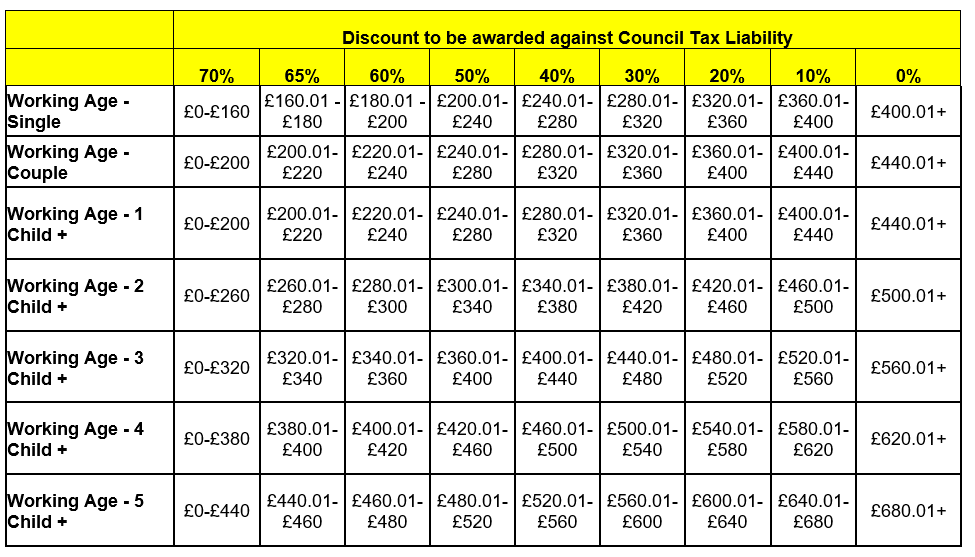
Under the proposed scheme, support would be based on weekly household income bands rather than being recalculated for every change in circumstances. Depending on household type and income level, eligible residents could receive between 10% and 70% support towards their council tax liability. Households whose income exceeds the upper threshold for their category would not qualify for support.
The following table illustrates the proposed scheme Income Bands and Claimant Type.
The key changes between this scheme and the current scheme are that:
- This scheme introduces income bands rather than using applicable amounts, enabling fluctuations in income without the need to re-calculate awards and issue additional letters and bills;
- A £25 income disregard is introduced for those who have earned income;
- Backdating of late claims will increase from 1 to 3 months;
We will use Department for Work and Pensions (DWP) data notifications of universal credit as an application and change of circumstances rather than waiting for the charge payer to apply.
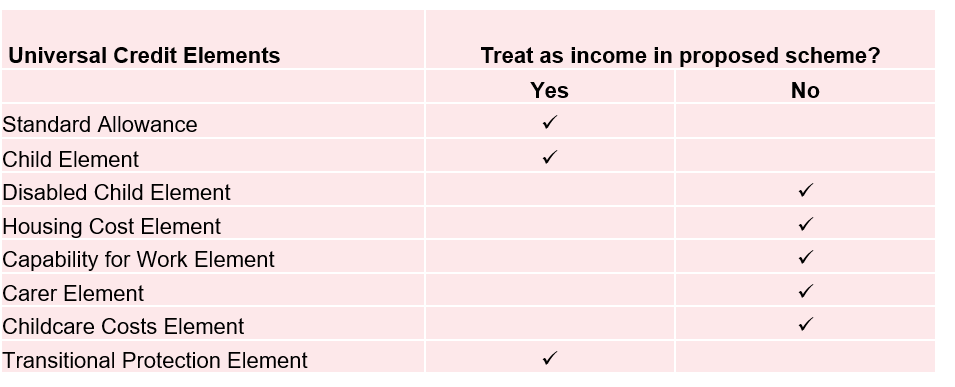
Most of our working age claimants receive Universal Credit, which is administered by the DWP, so using the notifications we receive, the following assessed elements will be treated as follows:
In addition, we propose disregarding the following income types:
- Child Benefit;
- Child maintenance/support for children;
- Personal Independence Payments;
- Disability Living Allowance;
- War Pensions;
- Fostering payments.
All other income (e.g. wages, self-employed income) will continue to be used to calculate income.
Capital income will remain capped at £6,000 and awards will be made up to a maximum of 70% of Band D council tax charges for properties that are Band D & above.
The Council's analysis suggests that most current claimants would see either no change or an increase in support under the proposed scheme. A number of households would receive a lower award, while only a very small number would no longer qualify for support.
The aim of the proposed changes is to provide a simpler, more stable and easier-to-understand scheme that reduces the impact of short-term income fluctuations and help residents manage their council tax payments more effectively.
Your feedback is important and will help the Council understand the potential impact of these proposals before a final decision is made.